
Slow Cooker vs. Instant Pot for Budget Family Cooking
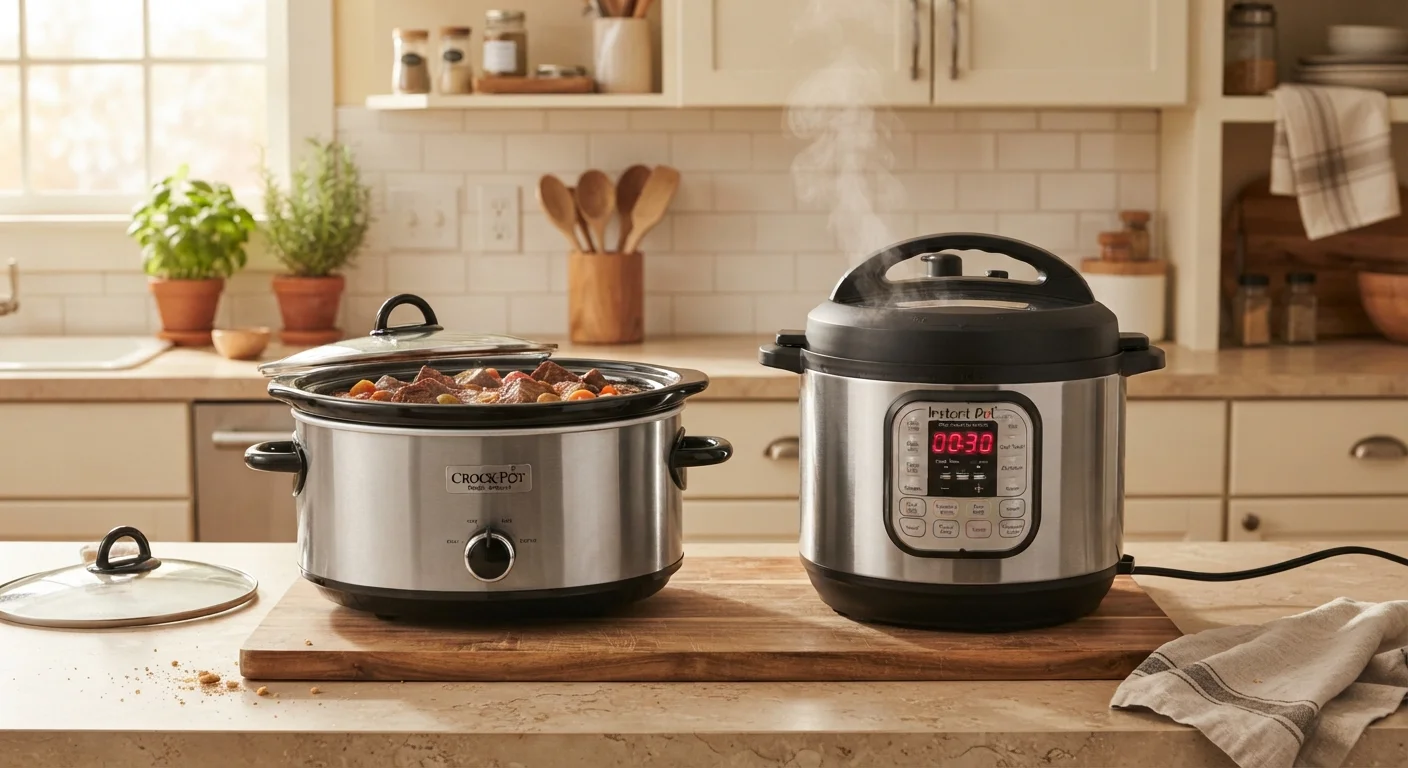
Photo credit: thetastyliving.com
In this article
Both appliances promise convenience and savings, but they work differently. See which one fits your family's schedule and spending habits.
Key Takeaways
- Slow cookers use less electricity per session but require 6 to 10 hours of cook time.
- Instant Pots cook most meals in 30 to 60 minutes, including pressurization time.
- Both appliances handle cheap, tough cuts of meat and dried legumes extremely well.
- Your family's daily schedule is the most reliable guide for choosing between them.
- Either appliance supports batch cooking, which lowers weekly food costs meaningfully.
How each appliance actually works
A slow cooker heats food gently over several hours using a ceramic insert and a low-wattage heating element. The long cooking time breaks down collagen in cheap cuts like chuck roast or chicken thighs, turning them tender without much attention from the cook. You add ingredients, set the dial to low or high, and walk away.
An Instant Pot is an electric pressure cooker with several additional functions. It traps steam to raise the internal pressure, which pushes the boiling point of water above 212 degrees Fahrenheit and speeds up cooking dramatically. A pot of beef stew that takes 8 hours in a slow cooker is done in roughly 35 minutes of pressure cooking, plus time to pressurize and release steam.
Neither method requires culinary skill. Both reward inexpensive ingredients. The difference is timing: one fits a long, unattended day; the other fits a short, attentive evening.
Cost of ingredients and energy
Both appliances shine with the cheapest grocery items: dried legumes, tough meat cuts, root vegetables, and whole grains. Dried beans are a clear example. In a slow cooker, soaked beans need 6 to 8 hours on high heat. In an Instant Pot, unsoaked dried beans are ready in about 25 to 30 minutes at high pressure. Either way, dried beans cost a fraction of canned, as covered in depth in our dried beans vs. canned beans budget comparison.
| Criterion | Slow Cooker | Instant Pot |
|---|---|---|
| Typical cook time | 6 to 10 hours | 30 to 60 minutes |
| Hands-on time required | Minimal after loading | Present for pressurization |
| Energy draw (approximate) | 150 to 300 watts | 700 to 1,000 watts |
| Energy per session (approximate) | 1.2 to 2.4 kWh | 0.5 to 0.75 kWh |
| Dried beans without soaking | 8+ hours needed | 25 to 30 minutes |
| Browning capability | Separate pan needed | Built-in saute function |
| Learning curve | Very low | Moderate |
| Functions | Slow cook only | Pressure cook, saute, steam, warm |
On electricity, a slow cooker running 8 hours at 200 watts uses about 1.6 kilowatt-hours per session. An Instant Pot at 1,000 watts for 45 minutes uses roughly 0.75 kilowatt-hours. At average U.S. residential electricity rates, the difference per meal is a few cents, so energy cost alone should not drive the decision.
Where cost savings compound is in ingredient choice. Both appliances make bone-in chicken thighs, pork shoulder, and dried beans taste far better than their price suggests. Pair either appliance with a batch cooking routine and weekly food spending can drop noticeably.
Weeknight scheduling: the real deciding factor
A slow cooker demands planning ahead. If dinner needs to be ready at 6 p.m. and the recipe calls for 8 hours on low, the food goes in by 10 a.m. For families with a predictable morning routine, that works well. For families whose mornings are already chaotic, it is a hard habit to build.
An Instant Pot fits the opposite schedule. You can decide at 5:30 p.m. that chicken and rice is dinner, and it is on the table before 7 p.m. The tradeoff is that someone needs to be present while it pressurizes and cooks, since the machine requires venting and monitoring in a way a slow cooker does not.
Good prep habits help both appliances perform better. Chopping vegetables and measuring spices the night before removes the morning friction that makes slow cooking feel impossible. The discipline behind that habit is the same one described in mise en place for budget cooking.
Where each appliance falls short
Slow cookers struggle with recipes that need a browning step. Searing meat before braising adds flavor, but you have to do it separately on the stovetop since the ceramic insert cannot get hot enough. Some families skip searing entirely, which is fine for soups and stews, but the result is noticeably less complex.
Instant Pots have a learning curve. Pressure cooking is not intuitive at first, and underestimating liquid requirements or cook times produces disappointing results. The saute function does allow browning inside the same pot, which cuts down on dishes, but it means standing at the stove for several minutes before sealing the lid.
A slow cooker also takes up counter or cabinet space and does exactly one thing. An Instant Pot does more but costs more upfront. If counter space or budget for the appliance itself is limited, that matters. See how scratch cooking in general compares to convenience shortcuts in our piece on meal kits vs. cooking from scratch.
Making either appliance work harder
Both tools become more economical when used for large batches. A 6-quart slow cooker can hold a full pot of chili that feeds a family of four twice. A 6-quart Instant Pot handles a double batch of lentil soup with room to spare. Cooking once and eating twice is one of the most reliable ways to reduce per-serving costs, a principle laid out in the batch cooking vs. daily cooking comparison.
Cheap cuts perform better in both appliances than on a stovetop or in an oven at comparable temperatures. Chicken legs, pork shoulder, beef chuck, lamb shanks, and whole dried legumes all benefit from long moist heat or pressurized steam. Building a weekly menu around two or three of these ingredients, then rotating preparations, keeps meals varied without raising costs. For a full framework on weekly food spending, the meal planning basics hub is a useful starting point.

Author
Dinner & Dessert Editorial Team
Dinner & Dessert Editorial Team is the collective byline for our editorial team and contributor network. Articles published under this byline or an editorial pen name are researched, written, and reviewed according to our editorial standards for clarity, consistency, and independence before publication.
View all articles →